


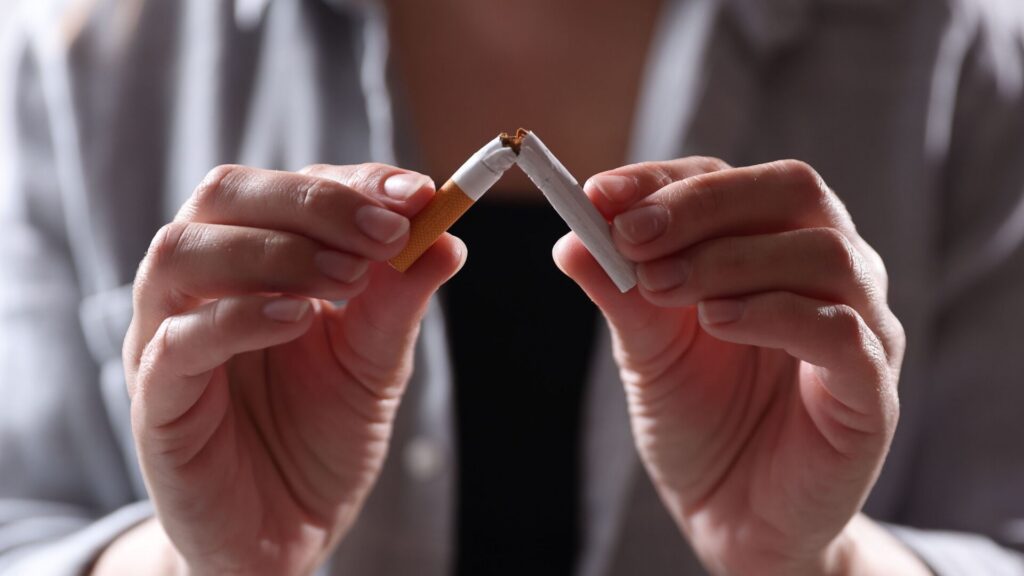
Quitting smoking: understanding the lack without guilt
Quitting smoking is first and foremost a human journey, sometimes marked by doubts and new sensations.
The lack is not a sign of weakness, but a natural response of the body and mind that adjusts after years of dependence on nicotine.
Understanding this lack is already the first step towards mastering it. By observing it without feeling guilty, we learn to recognize the body’s signals, to accept them, and to respond to them in a different way: through breathing, movement, or a new positive habit.
Why does the craving appear after stopping smoking?
When you quit smoking, your body reacts to the sudden drop in nicotine.
This substance stimulates the production of dopamine, the hormone of pleasure and reward.
When she disappears, the brain “demands” its dose — hence the cravings, the nervousness and sometimes a slight fatigue.
This is not a weakness: it is a natural chemical reaction.
Understanding this mechanism is already taking back control.
The role of the mind and habits
The role of the mind
The mind plays a central role in all processes of change. It is it that:
- Trigger the decision Nothing changes until the person says, «I want this to stop.».
- Keeps the motivation Quitting an addiction or changing behavior requires consistency. The mind must be focused on a clear goal (health, freedom, self-esteem…).
- Filters perceptions Our brain interprets reality according to our beliefs. If a person believes that smoking “relaxes,” they will have a hard time getting rid of it until they have reprogrammed that belief.
- Manages emotions The mind helps us recognize that stress or frustration does not necessarily require an immediate “reward” (like a cigarette).
The mental work consists therefore in:
- strengthening confidence in one's ability to change,
- creating positive images of the future without addiction,
- and develop the awareness of our automatic thoughts so that we no longer become their slaves.
The role of habits
Habits are the the foundation of daily behavior. They are automatic, so powerful — but also treacherous.
In an addiction, the act often becomes a habit. Ritual coffee → cigarette, break → cigarette, stress → cigarette.
To transform a habit, you need:
- Identifying the triggers the moment, the emotion, the situation.
- Replacing the behavior by a new routine (e.g. breathing, drinking water, short walk, sugar-free candy).
- Repeat until the brain adopts the new pattern.
This is the principle of the neuroplasticity The more you repeat a behavior, the stronger the associated neural connections become.
Changing a habit is therefore reprogramming the brain to act differently, without long-term conscious effort.
Mind and habits: an inseparable duo
- The mental It initiates the change (decision-making, motivation, confidence).
- The habits ensure the stability of change (anchoring, automaticity, comfort).
That is why effective support, like that provided at LaserAddict, acts both:
and on the behavior (replacement of the automatisms related to smoking).
on the mental (release, positive visualization, understanding of the mechanism of addiction),
De-programming of reflexes related to tobacco
Understanding the reflexes related to tobacco
When a person smokes, their brain associates the cigarette with specific situations, emotions, or rituals: the morning coffee, a break at work, a moment of stress, a discussion with friends, or simply the act of going out into the world.
Whenever this situation recurs, the brain automatically activates the «tobacco program.» It is no longer a conscious choice, but a conditioned reflex. It is the same mechanism that causes us to fasten our seat belts when getting into a car: a well-established automatic response.
The difference is that here, the behavior fosters dependence.
The principle of deprogramming
Deprogramming these reflexes involves cutting the link between the trigger and the smoking gesture.
In other words, it’s about teaching the brain that it can live through these same situations without cigarettes.
This process is carried out in three stages:
- Become aware of the triggers.
Identifying the moments when craving appears is essential.
For example: «I feel the urge to smoke when I finish a stressful call.» - Replacing the gesture.
It is not enough to eliminate the cigarette; we need to create a new response to the same trigger.
This can be drinking a glass of water, breathing deeply, taking a few steps, or simply refocusing on oneself. - Repeat until the brain is reprogrammed.
Whenever the brain experiences a trigger situation without a cigarette, it records a new positive experience.
Gradually, the old neural connections linked to smoking weaken, while the new ones strengthen.
This reprogramming process, over time, allows one to permanently free oneself from the automaticness of smoking.
The role of the laser in this approach
The laser stimulation used in LaserAddict It acts on reflex zones related to addiction, especially at the level of the ear, the face and the hands.
This action helps to rebalance the production of endorphins and significantly reduce the feelings of physical lack.
By soothing the body, the laser facilitates the deprogramming of mental and behavioral patterns.
The person can then focus on changing their habits without experiencing the stress of lack, which speeds up and consolidates the process of liberation.
In summary
The reflexes related to smoking are not innate: they have been learned, and can therefore be unlearned.
The goal is not to fight the craving, but to modify the response given to each triggering situation.
By combining the soothing action of the laser with mental reprogramming, it becomes possible to naturally free oneself from tobacco, without frustration and with real serenity.
How the laser helps manage the lack
The laser treatment stimulates specific points in the ear and the face, which are linked to stress and satisfaction.
This stimulation sends a message to the brain to restart the natural production of endorphins and serotonin.
It is a gentle, natural and painless approach, without chemical substitutes.
From the first session, many clients experience immediate relief and a noticeable reduction in the desire to smoke.https://fr.wikipedia.org/wiki/Comment_le_laser_aide_%C3%A0_g%C3%A9rer_le_manque#LaserAddict
Testimony from a customer
“I quit all of a sudden without feeling the lack. I was calm and relaxed.
The laser really helped me to get over it.”
— Marc, 42 years old, former smoker for 6 monthshttps://laseraddict.ch/temoignages/
Tips for coping well with the weaning period
- Drink plenty of water to eliminate toxins.
- Take a deep breath as soon as an urge arises.
- Walk or occupy your hands.
- Remember every day why you chose to quit.
Every passing desire is another victory towards your freedom.
Discover the LaserAddic method
At LaserAddict, we support every smoker on their journey towards a tobacco-free life using a natural and proven method.
In just one session, the laser helps to calm the body and mind while reducing the cravings associated with lack.
Take the first step today: Find the LaserAddict center closest to you and discover a new freedom.https://laseraddict.ch/centres-laser/
The LaserAddict team ✌️